





GQ magazine spoke to thirty-four people across the world of book publishing to get a sense of the “state of books” in America in 2026. The people surveyed agree that the publishing world as we once knew it is gone, but things aren’t all doom and gloom. New opportunities for writers to strike out on their own are materializing. Readers are finding community in unexpected places. As author and reading podcast host LeVar Burton points out, “The act of reading, and how we perceive readers, has changed. What was once seen as a solitary act has become a social one. Through platforms like BookTok, Bookstagram, and Substack, the reader is no longer a lone figure in an armchair. Now, they’re part of a vibrant and visible community.”
Writing Prompts
-
When Anne Carson, who was awarded the 2026 Nobel Prize for Literature, was asked in a Penn...
-
In the 2024 documentary Mistress Dispeller, director Elizabeth Lo uncovers a family...
-
Día de los Muertos or the Day of the Dead, a traditional holiday in Mexico with roots in...
Tools for writers
Daily News
October 26, 2026
October 26, 2026
The Authors Guild has joined a slew of other organizations in calling on the Australian government to change its copyright law to allow AI companies to train their models on authors’ works without permission. “The legislation would make it legal for your work to be exploited by AI companies, if they conducted that exploitation on Australian soil,” the Guild wrote in a statement. “It would effectively preempt the lawsuits authors have brought against AI companies and our lobbying for protections since the AI companies would simply move their training operations to Australia while continuing to deploy the models in the U.S.” Those interested in signing on to this statement can do so on the Guild’s website.
October 26, 2026
Short stories may be a tough sell in the world of publishing, but they’re proving popular in Hollywood, the New York Times reports. In recent years studios like Universal and Amazon MGM have purchased short stories for seven-figure sums. Executives facing piles of scripts are happy to read shorter work, and adapting unpublished short fiction can be easier than optioning a novel. “It’s such a good starting place rather than a completed blueprint,” Addison Duffy, an agent at United Talent Agency, said. “Producers, writers, and studios feel like they can help mold and shape it.”
October 23, 2026
Trends come and go at the pace of the internet, which means that publishers must figure out how to balance meeting the market with taking the time required to produce a physical book, USA Today writes. Between all the additional tasks on their plates and the many hurdles of the production process, rushing a book out can be a challenge. But while it may seem like audiences’ appetites are ever-changing, some in the industry point out that they’re actually more likely to get sick of a trend before readers do. “[Jessica] Faust[, the chief executive and founder of BookEnds Literary Agency,] offered an example where a hypothetical reader might discover a mermaid novel, while agents have already seen fifty manuscripts about mermaids.” Josh Rivera explains. “Publishers may have bought several before readers see the first.”
October 23, 2026
The Minnesota Star Tribune has taken a closer look at one small school in the town of Cook which has banned more books from its library than every other public school in Minnesota, Wisconsin, Iowa, and North and South Dakota combined, despite the fact that the state has banned book bans. The North Woods School in Cook pulled eighty books on subjects ranging from the Holocaust to dinosaurs, written by authors including Native American writers and Newbery Award-winners. Every book they pulled was added to the school’s collection at the request of a new library assistant named Quinn Krebsbach, who has since been fired. Krebsbach told that Star Tribune that his efforts, which included a display on banned books to mark Banned Book Week last year, were meant to “hopefully educate students a little bit about book challenges and intellectual freedom.” The superintendent of the school district said that the district is creating a policy for library materials, which was not in place when all of these books were pulled from shelves last year, and is working with the state education department and legal counsel to resolve the situation.
October 23, 2026
The Canadian publisher Les Éditions du Boréal has said that it is cutting ties with Thélyson Orélien after it came to light that the author used AI to write his debut novel C'était ça ou Mourir (It Was Either That Or Die), which was published earlier this year, Reuters reports. After the book won several major literary awards, allegations began to swirl online that it was written largely by AI. Orélien previously denied that he had used AI, but an investigation by his publisher found otherwise. “We still cannot know what capacity AI was used in the creation of It Was Either That Or Die, and undoubtedly we will never have a definitive answer,” the publisher said in a statement. “After the allegations, we continue[d] to trust [Thélyson] Orélien, who assured us he had never used such tools. This assertion has now been proven false.”
October 22, 2026
The U.K.’s Booksellers Association (BA) has said that bookstores in the region are unlikely to have legal issues if they sell copies of Sally Rooney’s books already in stock or imported from abroad, but that they should be cautious nonetheless, according to the Bookseller. The author and Faber, her U.K. publisher, recently announced that her books will no longer be sold in the country because she has pledged to give a share of her royalties to Palestine Action, a group which has been banned by the British government. In the wake of this news, many bookshops, including some in the U.K. and Ireland, have stated their support for Rooney and sales of her books have skyrocketed. “We have been unable to find any evidence to suggest that selling current stock or, in the future, purchasing books from wholesalers outside of the U.K. and offering them for sale in the U.K. will result in Sally Rooney being paid royalties she has said will be used to support Palestine Action,” Meryl Halls, the managing director of BA, is quoted saying.
October 22, 2026
On October 19, nearly three hundred authors filed individual copyright infringement claims against Meta across five complaints rather than join a class action lawsuit in which a few named plaintiffs sue on behalf of many more people, Publishers Weekly reports. The plaintiffs are alleging that Meta trained its AI models on pirated copies of their books and on physical books the company bought and scanned without permission to do so, and include authors Jacqueline Winspear, Reyna Grande, and Mark Spragg. But some have reservations about this approach. “The Authors Guild stands with the authors who filed suit against Meta and supports their efforts to hold the company accountable for copyright infringement. We are especially glad to see the complaint take on Meta’s mass scanning operation to train AI as an independent act of infringement,” Mary Rasenberger, the chief executive of the Authors Guild, said. “At the same time, we believe that authors must stick together to ensure that the law protects all authors against the blatant theft of their work by AI companies through well-conceived class action lawsuits.”
October 22, 2026
The Independent Publishers Caucus has released the Independent Press Top 40 best-seller lists for the week ending October 18, 2026. The lists, in fiction and nonfiction, are compiled in partnership with the American Booksellers Association and identify “the top titles from independent presses as represented at independent bookstores across the U.S.” This week on the fiction list, The Calamity Club by Kathryn Stockett (Spiegel & Grau) once again retains the top spot. New to the fiction list are Solace House (Grove Press) by Will MacLean, at no. 15; Rottenheart (Zando) by Kat Dunn, at no. 16; Caught Up (Collector’s Edition) (Into Darkness Series) (Slowburn) by Navessa Allen, at no. 30; Cloud Runner: Poems (Norton) by Joy Harjo, at no. 31; and The Spirits: A Novel (Norton) by Bonnie Jo Campbell, at no. 36.
October 21, 2026
Catapult is being sold and operations will wind down at the end of this month, Publishers Lunch reports. The Catapult union, which formed in June, said plans for a sale came to light while the NLRB vote was happening and that “continued employment with the prospective buyer is not an option.” A termination deal for affected employees is still being finalized.
October 21, 2026
BookInsights.ai, a data consultancy launched by a former Circana BookScan executive, surveyed over five thousand U.S. book buyers and found that 28 percent don’t want AI to play any role in creating books, Publishers Weekly writes. On the flip side, 22 percent said they are fine with AI being used at any stage of writing or publishing. “The results diverged sharply among age groups: 36 percent of teenagers are open to AI being used at any stage of the writing of a book, while only 11 percent of people over fifty-five agreed,” Natalie Chandler notes. “However, a clear majority of readers of all ages—85 percent—said books should disclose whether AI was used in the writing process, the survey said.”
October 21, 2026
The Society of Authors (SoA) has withdrawn from the ethical AI charter it announced last week, according to the Bookseller. The charter calls on members and industry organizations to “pledge to only use generative AI in a transparent, responsible, and ethical way, balancing the technological benefits with the potentially devastating impact on people and planet.” But after it was publicized, SoA members voiced criticism both about the contents of the charter and about the fact that members weren’t consulted before it was published. SoA has withdrawn in order to hear from its members, but none of the other participant organizations have followed in their footsteps, and the charter is still live.
October 20, 2026
A new French literary prize known as the Prix Pascal will recognize writing produced with the help of AI, the Bookseller reports. Entrants must specify what AI tools they used and how they used them in enough detail that another writer could reproduce their methods, and must submit their initial prompt alongside a manuscript of between 10,000 and 50,000 words. “The organizers want submissions to address ecological, social, or ethical challenges, whether by drawing attention to a problem or proposing an original way of tackling it,” Melina Spanoudi writes. “Their stated aims include encouraging the use of AI, connecting France’s literary prize tradition with its AI industry, and assessing the technology’s literary capabilities.”
October 20, 2026
Penguin Random House will be bringing back its annual two-day holiday transit program to help independent bookstores avoid suffering from shipping delays, Publishers Weekly writes. Booksellers are permitted to submit orders of any size and PRH guarantees that it will expedite shipping orders to independent shops so that they arrive within two days throughout the holiday season. “The program includes all frontlist and backlist physical-format titles from the imprints of the Crown, Knopf Doubleday, Penguin, and Random House publishing groups; Random House Children’s Books; Penguin Young Readers; PRH Audio; and DK Publishing, as well as titles from all PRH Publisher Services clients,” Claire Kirch explains. The initiative began in 2011.
October 20, 2026
Four Supreme Court justices have recused themselves from considering an appeal in a copyright case involving the music company BMG Rights Management, Publishers Lunch writes. BMG is owned by Bertelsmann, which also owns Penguin Random House, and the judges in question—Sonia Sotomayor, Neil Gorsuch, Amy Coney Barrett, and Ketanji Brown Jackson—have all written books for the publisher. But these recusals have left the court without a quorum, which lets stand the earlier appellate court ruling. Further, this development “suggests that for now the high court could be unable to review any case involving Bertelsmann or its subsidiaries,” Michael Cader points out.
October 19, 2026
A new profile in the New Yorker calls James Daunt, the CEO of both Barnes & Noble and Waterstones—the largest bookstore chains in the U.S. and U.K., respectively—the “most important man in bookselling.” Since taking charge of the former in 2019, he has encouraged each location to operate more like an independent bookstore, giving booksellers the opportunity to take ownership of their work while also catering to customers who differ widely from city to city. And he’s pushing back on the idea that reading is falling out of fashion. “Such nonsense,” he is quoted saying on the subject. “It’s ‘Policemen always get younger’—we just go through an arc of life. Every single year of my bookselling life, somebody has popped up and said, ‘Literary fiction is dead!’” But in reality, that hardly seems to be the case. Case in point: Sales of print books have increased nearly 25 percent in the last decade.
October 19, 2026
Hachette Book Group’s sales rose 4 percent in the third quarter compared to 2025, Publishers Weekly writes. The bump in sales was driven by bestsellers published this year including The Counterrevolution (Basic Books) by Victor Davis Hanson and Perilous Fight (Legacy Lit) by Colin Kaepernick. David Shelley, the chief executive of Hachette, also wrote in a news release that “enormous sales of puzzle books” has also been a recent trend.
October 19, 2026
Isabel Allende has won the €1 millon (approximately $1,122,000) Premio Planeta literary prize under a pseudonym, the Guardian reports. The Spanish prize is one of the most lucrative literary awards in the world, and Allende won with La Hora Antes Del Alba, a sequel to her debut novel, The House of the Spirits (Knopf, 1985). Though Allende submitted the unpublished manuscript under the name Luz Ventura, some have speculated that the prize judges may have picked up on her style. “I had never entered a competition because I wanted to avoid the embarrassment of coming last,” Allende, who is 84, is quoted saying. “At my age, there is very little to lose.”
October 16, 2026
Andrea Bartz, the thriller novelist and lead plaintiff in the landmark Anthropic copyright infringement lawsuit, argues that artists are leading the way towards reining in AI oligarchs in the Los Angeles Times. Creatives, she points out, are people whose work shapes our culture and encourages everyone else to recognize their own and other people’s humanity. “Many artists feel exploited right now; after all, as our lawsuit showed, these AI companies now worth hundreds of billions of dollars stole our work without compensation or consent, all with the goal (in some cases explicitly) of putting us out of business. But the very thing they tried to take from us—our creativity, our drive to make something that resonates with people—is what we’re using against them in films, in books, and in speeches.”
October 16, 2026
YouTube is talking to publishers about developing an audiobook feature, according to the Wall Street Journal. It’s unclear what audiobooks would look like on the video platform or whether users would have the option of buying individual books rather than purchasing a subscription as a package deal with other products bundled together as part of YouTube Premium, but offerings could become available as early as next year. “[P]ublishing-industry executives believe there is still an opportunity in tapping in to YouTube’s massive audience and are eager to find a revenue-generating alternative to the glut of unauthorized audio versions of their books that now appear on the platform,” Alexandra Bruell and Anne Steele write.
Literary Events Calendar
- October 29, 2026
Virtual Craft Chat w/ Author Amber Blaeser-Wardzala
Online7:00 PM - 8:00 PM EDT - October 31, 2026
Susan Michele Coronel, Josephine LoRe, Charles S. Colbean,
Online2:00 PM - 4:30 PM EDT - November 1, 2026
Submission Sunday (Zoom)
Online12:30 PM - 2:30 PM EST
Readings & Workshops
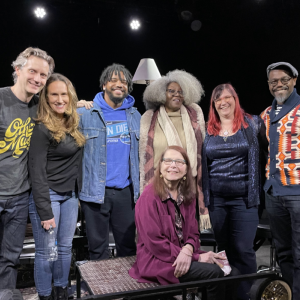
Veteran Voices Reflection produced by Poetic Theater Productions. March, 2023.
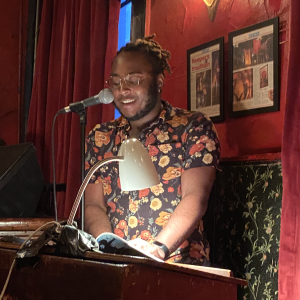
KB Brookins reading at the Queer South Reading Series - Queer South II. May, 2023.
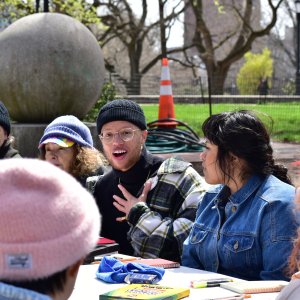
Najee Omar leading a public workshop at Fort Green Park Conservancy’s Poetry in the Park series. April 2023, Brooklyn, NY.
Poets & Writers Theater
In this Waterstones interview, R. F. Kuang talks about the idea of linguistic relativity in the ways language can shape people’s experience of the world, and how the loss of her grandmother inspired her latest novel, Taipei Story (William... more
Most Recent Items

Classifieds
Writing contests, conferences, workshops, editing services, and more.
Jobs for Writers
Search for jobs in education, publishing, the arts, and more.