This week’s installment of Ten Questions features Monica Datta, whose novel Nebraska is out today from Astra House. It’s Thanksgiving 2006, and the Chatterjees are not alright. Prabir Chatterjee has arrived at a prison in upper upstate New York to collect his wife, Anna, who has just spent fourteen years behind bars for manslaughter after she jumped in front of a train and took their eight-year-old son with her. The elder children, Nina and Neal, have barely spoken to their mother—or each other, for that matter—in years. So, imagine everyone’s surprise when they reunite for Anna’s return home only to discover that she is long gone. The problem is that they don’t know where she went. The ensuing family story is entangled with that of the Lacanian Jean-Louis Katz and the annotations of B.X. Roy, a psychoanalyst revisiting the intergenerational, international saga from the vantage point of 2025. In a starred review, Kirkus Reviews called Nebraska “a busy novel, but it’s all delivered with verve, humor, and a bone-deep comprehension of the immigrant experience, and of the ugliness and neglect that accompany traditional assimilation.” And in Vulture, Jasmine Vojdani writes, “Datta moves through time, perspective, and space—from Nebraska to India to Scotland—to probe the forces big and small that led to the central tragedy.” Monica Datta is a fiction writer, architectural designer, and professor at Pratt Institute. She holds degrees in architecture and urbanism from the City University of New York, the London School of Economics, and the Bartlett School of Architecture at UCL as well as an MFA in creative writing from Washington University in St. Louis. Datta’s writing has been published in the Believer, the New Inquiry, Blackbird, and elsewhere, and she is also the author of Thieving Sun (Astra House, 2024).
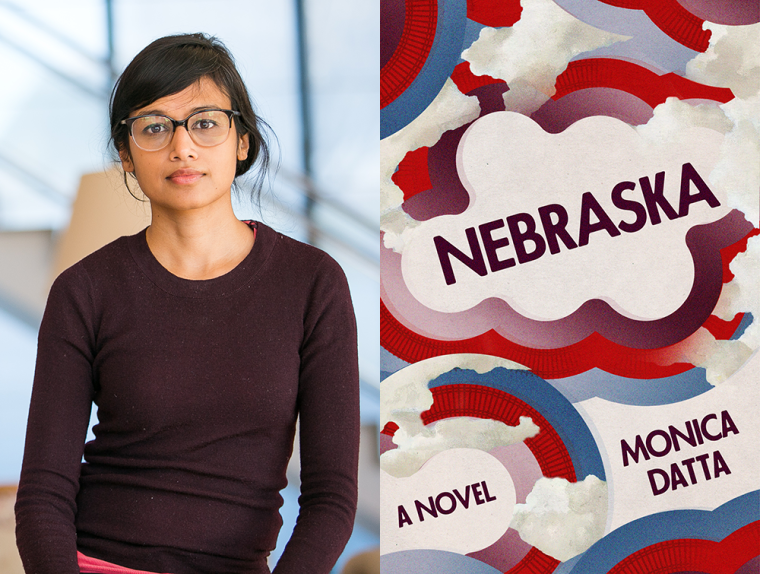
Monica Datta, author of Nebraska (Credit: Martí Albesa)
1. How long did it take you to write Nebraska?
Nearly twenty years—I will always remember the date on which I started it because it was the day on which the first part of the book takes place: the day before Thanksgiving, 2006.
2. What was the most challenging thing about writing the book?
Maintaining elements in tension with one another: the characters at different ages and stages of their lives with the ends of empire and the erosion of the postwar state, the clarity of the characters’ emotional lives with the heaps and tons of information that the novel’s annotator considers essential to a reader’s understanding of the story, the central horror of the novel with the absurdity that shapes it.
3. Where, when, and how often do you write?
In successive charrette modes, late into the evening.
4. What are you reading right now?
I just read Halldór Laxness’s Independent People (Vintage, 1997) during a trip to Iceland. It’s beautifully written but the story is relentless. It helped me to appreciate a country that seems to have changed a great deal over the past hundred years without losing itself.
5. What, if anything, will you miss most about working on the book?
Finishing it felt like no less than the end of summer and all of its promises. The characters have become very dear to me—there is very little I don’t know about them.
6. What is the biggest impediment to your writing life?
Time in all of its forms.
7. What is one thing that your agent or editor told you during the process of publishing this book that stuck with you?
When I was reluctant to finish the book, my editor reassured me that Nebraska is a living novel: It is constantly being written. I’m fairly sure that he meant this was the case for me, that I would never stop dreaming of these characters and their lives, but I also hope that it’s true for a reader, through their own experiences.
8. If you could go back in time and talk to the earlier you, before you started Nebraska, what would you say?
I would feel obligated to tell myself that it would take twenty years for the book to be published, but can only hope that my past self wouldn’t shrug and say she had all night to work on it.
9. Outside of writing, what other forms of work were essential to the creation of Nebraska?
My favorite part of writing the book was imagining the other characters’ work, what it might be like to know what they knew, to be good at what they did, what it might be like to practice as a Lacanian psychoanalyst who qualified as a psychiatrist versus one with a doctorate in behavioral neuropsychology (neither of which are typical) who had lapsed, or for that matter to be a research chemist, a painter, and so on.
10. What’s the best piece of writing advice you’ve ever heard?
I believe that a wise man told us all to fail better.