Eastern Oregon University
MFA Program
Poetry, Fiction, Creative Nonfiction
La Grande, OR
Application Deadline:
Sun, 02/01/2026
Application Fee:
$50
Affiliated Publications/Publishers:
Jump to navigation Skip to content
James Dickey Review
The Seasons in Quincy: Four Portraits of John Berger is a documentary about art critic, novelist, essayist, painter, and poet John Berger, whose latest essay collection is Landscapes: John Berger on Art (Verso Books, 2016). Cowritten by Ben Lerner and Tilda Swinton, the film was released in August 2016.
Corporeal Voices has launched a new $10,000 grant for Oregon writers. The Voice is a Muscle Grant will be awarded annually to an Oregon poet, fiction writer, or nonfiction writer. The 2017 grant will be given to a writer of color; the 2018 grant will be given to a LGBTQ writer.
“We are dedicated to amplifying artistic voices by extending direct financial resources to writers,” write the staff of Corporeal Voices. “Your artistic labor is important and urgently needed. Art is the counter voice to cultural repression. Writers matter.”
Using the online submission system, writers of color may submit up to 20 pages of poetry or prose by December 5; there is no entry fee. Students enrolled in a degree-granting program are not eligible to apply. The winner will be notified by December 25.
The grant is administered by Corporeal Voices, a nonprofit foundation dedicated “to recognizing the voices, bodies, and lives of writers as socially vital to society.” Established by writer Lidia Yuknavitch, Corporeal Voices is “committed to non-hierarchical collaborations, to the body as a site of resistance and resilience, to new forms of storytelling, and to new relationships to the planet and to one another.”
Do you write novels, short stories, or essays? Spend some time this weekend polishing those manuscripts; below is a round-up of prose contests with a deadline of November 15. These contests offer prizes ranging from $1,000 to $20,000, as well as publication.
For short prose writers looking to submit a full-length manuscript, the Pleiades Press Robert C. Jones Prize for Short Prose awards $2,000 and publication by Pleiades Press for a collection of short stories, flash fiction, essays, or lyric essays. Jenny Boully will judge. Submit a manuscript of 90 to 200 pages with a $25 entry fee.
Another opportunity for short prose writers—very short prose writers, that is—is Quarter After Eight’s Robert J. DeMott Short Prose Contest, which awards a prize of $1,008.15 and publication in Quarter After Eight for a single prose poem, a short short story, or a micro-essay. Ander Monson will judge. Submit up to three pieces of no more than 500 words each with a $15 entry fee, which includes a subscription to Quarter After Eight.
In addition to $3,000 and publication in Writer’s Digest, the winner of Writer’s Digest’s Short Short Story Competition will receive an all-expenses-paid trip to the Writer’s Digest Conference in August 2017 in New York City. Using the online submission system, submit a story of up to 1,500 words with a $20 entry fee; the entry fee goes up to $25 after November 15.
One of the world’s richest prizes for a collection of short fiction, the Story Prize annually awards $20,000 for a book published in the previous year. Two runners-up will each receive $5,000, and one entrant will receive the $1,000 Story Prize Spotlight Award, given for a collection that merits further attention. Larry Dark and Julie Lindsey will select the three finalists and the Spotlight Award winner; Harold Augenbraum, Sarah Shun-lien Bynum, and Daniel Goldin will choose the Story Prize winner. Publishers, authors, or agents may submit two copies of a book published between July 1 and December 31, 2016 with a $75 entry fee. (The deadline for books published during the first half of the year was July 15.)
The Pushcart Press Editors’ Book Award occasionally offers a prize of $1,000 for a fiction or nonfiction manuscript that has been rejected by a commercial publisher and “overlooked by today’s high-pressure, bottom-line publishing conglomerates.” An editor at a U.S. or Canadian publishing company must submit a formal letter of nomination. There is no entry fee.
Visit the contest websites for complete guidelines and submission details. For more upcoming contests, visit our Grants & Awards database and Submission Calendar.
As the dust settles from this year’s U.S. presidential election, think of a time in your youth when you participated in a school election or were involved with the student council. Were you optimistic of the changes that could be made? Did you vote with enthusiasm or take part in any protests? Write an essay reflecting on your experiences and what was important to you then, and how this might say something about who you are today.
Last night at a ceremony in Austin, Texas, Kirkus Reviews announced the winners of the third annual Kirkus Prize. Three awards of $50,000 each are given for a book of fiction, nonfiction, and young readers’ literature published in the previous year.
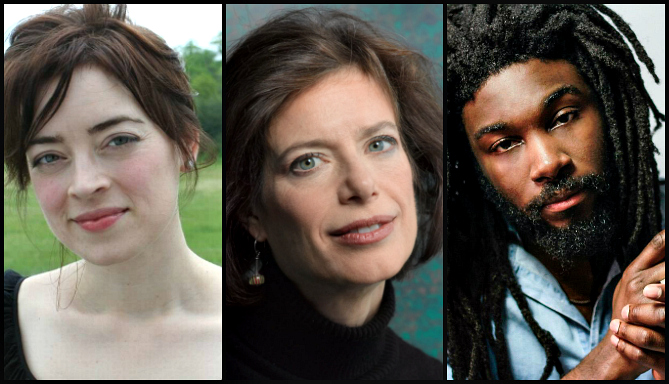
C. E. Morgan won the fiction award for her second novel, The Sport of Kings (Farrar, Straus and Giroux). Fiction writer Claire Messud, bookseller Annie Philbrick, and Kirkus Reviews critic Gene Seymour judged.
Pulitzer Prize–winning journalist Susan Faludi took home the nonfiction prize for In the Darkroom (Metropolitan). Writer Jim Piechota, bookseller Chris Schoppa, and journalist and novelist Héctor Tobar judged.
Jason Reynolds won the young readers’ literature prize for his novel As Brave As You (Caitlyn Dlouhy). Bookseller and author Elizabeth Bluemle, Kirkus critic and librarian Deborah D. Taylor, and National Book Award–winning author Jacqueline Woodson judged.
The winners were selected from 1,154 titles that received a Kirkus starred review between November 1, 2015, and October 31, 2016, for fiction and nonfiction, and between October 1, 2015, and September 30, 2016, for young readers’ literature.
One of the world’s richest literary awards, the Kirkus Prize was established in 2014 to honor the eighty-first anniversary of Kirkus Reviews, a publication that today provides review coverage of more than seven thousand commercially published books, as well as more than three thousand self-published books, each year. For more information about the prize, as well as a list of finalists in each category, visit the Kirkus Reviews website.
(Photos from left: C. E. Morgan, Susan Faludi, Jason Reynolds)
“I didn’t understand that I had to be ruthless. I didn’t understand that my job as a writer wasn’t to coddle my characters and create these fairy tales for them to live.” At Brown University's Center for the Study of Race and Ethnicity in America, Jesmyn Ward and Edwidge Danticat discuss writing about their homes and the power of place.
“Sometimes the humor is a way to mask all that, so the reader won’t know that what I’m writing about is me, or figure out what side of the argument I stand on. Then there’s a risk in just trying to say what you mean to say…. Writing is a risk no matter what.” In a 2015 interview with Chris Jackson for the Paris Review, Paul Beatty, who was awarded the 2016 Man Booker Prize for his novel The Sellout last week, speaks about the risks of criticizing and including heated topics in his writing. Think of a topic or stance you are personally drawn to—but also afraid of—writing about. Write a personal essay in which you gradually expose this risky issue or opinion in a humorous way. How can offbeat humor, satire, or a generally funny approach allow you to tackle difficult subjects in a more oblique way?
At Yale University, Viet Thanh Nguyen discusses his award-winning novel, The Sympathizer (Grove Press, 2015), and his latest book, Nothing Ever Dies: Vietnam and the Memory of War (Harvard University Press, 2016), which is a finalist for the 2016 National Book Award in nonfiction.