




Manipulating the Shape of a Story

The author of Clutch (Tin House, February 2026) reflects on adjusting rising and falling action across time in fiction.
Tags:
Jump to navigation Skip to content
The author of Clutch (Tin House, February 2026) reflects on adjusting rising and falling action across time in fiction.
Argentine French author Copi introduces himself as the recipient and translator of a series of letters from a Parisian rat named Gouri to his former “master” in the 1979 novel City of Rats, translated from the French by Kit Schluter in a new edition forthcoming in March from New Directions. In the faux “Translator’s Preface,” Copi writes, “Decryption is not always a simple matter, although I think I’ve managed to the best of my ability here, even if certain passages penned in the rats’ language (two or three entire paragraphs of nothing but the letter ‘i,’ for example) fell away under my ruthless scissors.” Throughout the zany, fabulist narrative that is both whimsical and sexually obscene, the rat embarks on a reckless journey of adventure and crime. Write a short story in which you pose as the recipient of letters from a nonhuman character. As you select your character, consider the thematic possibilities that can be plumbed and how you might explore elements of conventional fables.

A novelist explores the decision to name real places in fiction, the way maps circumscribe those places, how locales heavily defined by tourism are susceptible to those projections, and what it means to push against those expectations.

T Kira Māhealani Madden’s new novel, Whidbey, asks challenging questions about how we as a society treat and talk about both the survivors and perpetrators of sexual abuse.

Boa Editions celebrates a half century of independent publishing and releases a previously unpublished collection of Lucille Clifton’s poetry.
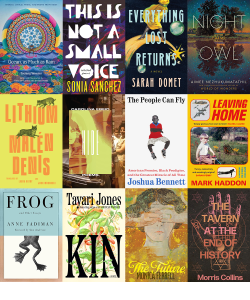
The first lines of a dozen noteworthy books, including Night Owl by Aimee Nezhukumatathil and Frog: And Other Essays by Anne Fadiman.

The author of Clutch (Tin House, February 2026) reflects on poetic time, dialogue, and writing effective scenes.
Millay House Rockland offers two monthlong residencies, one in October and one in July, to poets, fiction writers, and nonfiction writers in the duplex where the late poet Edna St. Vincent Millay was born in Rockland, Maine. Residents receive a $1,200 stipend from the Ellis-Beauregard Foundation and are provided with a private bedroom, a private bathroom, a study, a porch, and a fully equipped kitchen. Residents are responsible for their meals. During their residency, residents are asked to offer one public event.
Millay House Rockland Writing Residency, P.O. Box 831, Rockland, ME 04841. (619) 840-7201. Melissa McKinstry, Board Member and Writing Residency Coordinator.
The 2026 Himalayan Literature Festival and Writers Workshop, sponsored by White Lotus Book Shop, will be held from May 29 to June 5 at the Malla Hotel in Kathmandu, Nepal. The writers workshop, which takes place from May 29 to June 3, includes two workshops held in temples and Buddhist monasteries, two workshops led by Himalayan shamans, and excursions to historical and cultural sites. The festival, which takes place from June 4 to June 5, features craft talks, reading events, and book launches for poets, fiction writers, nonfiction writers, and translators.
Himalayan Literature Festival & Writers Workshop, White Lotus Book Shop, Hanumanthan, Kupondole, Kathmandu, Nepal. (981) 379-8573. Shreejana Bhandari, Director.
