Octavia Books
Octavia Books is an independent, locally-owned bookstore located uptown in New Orleans. The store regularly hosts author events such as signings, readings, and talks.

Tags:
Jump to navigation Skip to content
Octavia Books is an independent, locally-owned bookstore located uptown in New Orleans. The store regularly hosts author events such as signings, readings, and talks.
Garden District Book Shop resides inside the historic property called the Rink at the corner of Washington Avenue and Prytania Street, in New Orleans’s Garden District. They carry a large collection of new and used regional titles; design, art, and gardening books; fiction and non-fiction; and signed first editions and limited editions by many regionally and nationally acclaimed authors.

Auntie's Bookstore opened in 1978 in the Spokane Flour Mill under the name of “The Book and Game Company” and has been selling books ever since. Auntie’s moved to its current location in the Liberty Building in 1994. The store carries both new and used books, cards, t-shirts, Spokane specialty items, and other gifts. A full-service independent bookstore, this venue holds events, readings, signings, storytime, and more throughout the year.

Last night Steven Millhauser took the Story Prize, the annual award celebrating a short story collection published in the previous year, at a ceremony in New York City. Following readings by the author, who began his career as a novelist (a Pulitzer Prize–winning one, at that), and his fellow finalists, Don DeLillo and Edith Pearlman, Millhauser's We Others (Knopf) was announced as the selection for this year's twenty-thousand-dollar award.
Millhauser, who admits influences ranging from Dr. Seuss's And to Think That I Saw It on Mulberry Street to makers, inventors, and craftsman (including those ne'er-do-wells of his youth who revealed their secret, and unmatched, talents in woodshop), was recognized for his skill at pushing the boundaries of the imaginative process. As prize director Larry Dark noted in his onstage interview with the author, one uniting feature of Millhauser's oeuvre is the "escalation of efforts" exemplified in stories such as "Snowmen," which the author presented last night. Millhauser followed the story with a reading of a "thingamajig," which he asked the audience to regard as such, avoiding classifying the two-minute lyric romp as a "poem" or "story."
Both DeLillo, shortlisted for The Angel Esmeralda (Scribner), and Pearlman, a finalist for Binocular Vision (Lookout Books), took home five thousand dollars each. The judges for this year's award were author Sherman Alexie, translator Breon Mitchell, and Louise Steinman of the Los Angeles Public Library.
After the prizes were presented (and the authors swamped with readers seeking autographs), the evening wound down with a party for the finalists, an intimate celebration in a Greenwich Village restaurant befitting the tiny beauty of, as DeLillo put it, "the classic American form."
Record the slogans you see on billboards and in other advertising as you go about your daily routine—Prescription Drug Misuse Is a Growing Trend; Forever Engagements; Truth & Honesty: That's the Manfredi Way! Choose one from the list you've gathered and use it as the opening line for a story.
Elizabeth Anderson is the program director at P&W–supported Charis Books and More and Charis Circle, a unique for-profit independent feminist bookstore and 501(c)(3) social justice literary nonprofit hybrid located in Atlanta, Georgia. She is also a writing coach and fiction writer at work on her first novel, "Paradise Park." What makes your reading series unique?
Charis Books is turning thirty-eight this year. With bookstores continuously closing, we will be the oldest feminist bookstore in North America and the primary LGBT-focused bookstore in Atlanta. Our events have always reflected the old feminist axiom, "the personal is political." We believe that fiction has the power to change the world and that reading can be a revolutionary act. We maintain a deep investment in helping to center voices traditionally at the literary margins.
What recent program have you been especially proud of?
The P&W–sponsored evening with Sassafras Lowrey, editor of Kicked Out, an anthology of work by homeless LGBTQ youth. Sassafras shared her own story of homelessness and talked about receiving one teen's story via text message because the kid didn't have access to traditional modes of journalistic communication. Sassafras opted to publish it in the book with a standard English translation. That anecdote spoke to me about the value of telling our story despite the obstacles.
What’s the craziest thing that’s happened at an event you’ve hosted?
The life of a bookseller is a crazy one. We hear more confessions than priests and doctors. People share. A LOT. Folks come to a reading about how to turn a front lawn into a food producing garden and end up talking about their grandmas who, as it turns out, were from the same small town. By the end of the night, you have complete strangers hugging and smiling and trading recipes and crying over long dead people. That is the wonder of a reading at Charis.
How do you cultivate an audience?
It's about relationships. It's about remembering people's names and tastes. I call people on the phone. I invite people personally via e-mail and on Facebook. If someone buys an author's book, I remember. If that author is slated to read at our store six months later, I make sure to remind the customer. If the independent bookstore is to survive, it will be because of relationships.
How has literary presenting informed your own life?
It has made me a better writing coach: I can tell you exactly the moment at which you will begin to bore your audience (seventeen minutes, don't ever read for more than seventeen minutes straight, I don't care if you sound like James Earl Jones and are the best looking person on the planet, people will start to glaze).
What do you consider to be the value of literary programs for your community?
All writers and readers have the potential to be activists if they choose. Bookstores are gathering grounds. They are the places to come and recharge your batteries or lick your wounds or rebuild after a hard political battle. At Charis, we fight to keep the doors open for our community because we believe there is a kind of grace in the act of gathering around stories no other space in our culture can provide.
Photo: Elizabeth Anderson.
Support for Readings/Workshops events in Atlanta is provided by an endowment established with generous contributions from the Poets & Writers Board of Directors and others. Additional support comes from the Friends of Poets & Writers.
The New York Public Library has announced the five finalists for its twelfth annual Young Lions Fiction Award, given to an emerging writer for a work published in in the previous year. The winner of the honor, which carries a prize of ten thousand dollars, will be announced on May 14.
The 2012 finalists are Teju Cole for Open City (Random House), Benjamin Hale for The Evolution of Bruno Littlemore (Twelve), Ben Lerner for Leaving the Atocha Station (Coffee House Press), Karen Russell for Swamplandia! (Knopf), and Jesmyn Ward for Salvage the Bones (Bloomsbury). Salvage the Bones, Ward's second novel after her breakout, Where the Line Bleeds (Agate Publishing, 2008), won the National Book Award in fiction last fall. Cole's debut was a finalist for this year's National Book Critics Circle Award.
Recent winners of the NYPL's top honor for emerging writers are Adam Levin for The Instructions (McSweeney's Books, 2010), Wells Tower for Everything Ravaged, Everything Burned (Farrar, Straus and Giroux, 2009), and Salvatore Scibona for The End (Graywolf Press, 2008). The award is an program of the library's Young Lions, a group of donors in their twenties and thirties.
In the video below, finalist Teju Cole presents "a sneak peak" into his nascent nonfiction project at Franklin Park bar in Brooklyn, New York.
Choose an article from a magazine that profiles a person, such as a celebrity, a political figure, or a professional athlete. Using one of the settings in the article and a fictionalized version of the person as the main character, write a story in which it is revealed that the main character's greatest strength is also his or her greatest failing.
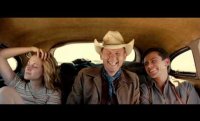
The highly anticipated film adaptation of Jack Kerouac's On the Road finally has a trailer. Set to premiere in the U.K. on September 21, director Walter Salles's movie stars Sam Riley as Sal Paradise, Garrett Hedlund as Dean Moriarity, and Kristen Stewart as Dean's wife Marylou. A release date for the U.S. has not been set.