




The Written Image: Swann's Way

French artist Stéphane Heuet’s Herculean efforts to democratize the work of Marcel Proust come to fruition as Norton releases his graphic-novel adaptation of Swann’s Way.
Tags:
Jump to navigation Skip to content
Articles from Poet & Writers Magazine include material from the print edition plus exclusive online-only material.
French artist Stéphane Heuet’s Herculean efforts to democratize the work of Marcel Proust come to fruition as Norton releases his graphic-novel adaptation of Swann’s Way.
Small Press Points highlights the innovation and can-do spirit of independent presses. This issue features the Plano, Texas–based Queen’s Ferry Press. Initially devoted to short story collections, the press is now expanding to publish novels, novellas, and an anthology series.

In a continuing series examining the lives of writers in the international writing community, contributing editor Stephen Morison Jr. spends time with three authors in Rome who share a common desire "to shake free from a past so impressive it's suffocating."

Should you pay to have a manuscript edited beforehand? Are there benefits to querying via snail mail versus e-mail? Danielle Svetcov of Levine Greenberg Rostan answers readers’ questions about what (and what not) to do when trying to find an agent.
With so many good books being published every month, some literary titles worth exploring can get lost in the stacks. Page One offers the first lines of a dozen recently released books, including Toni Morrison’s Gold Help the Child and Charles Simic’s The Lunatic, as the starting point for a closer look at these new and noteworthy titles.
Literary MagNet chronicles the start-ups and closures, successes and failures, anniversaries and accolades, changes of editorship and special issues—in short, the news and trends—of literary magazines in America. This issue’s MagNet features Rattle, Poetry International, the Moth, Grain, and Barrelhouse.

Small Press Points highlights the innovation and can-do spirit of independent presses. This issue features the Fairfax, Virginia–based Civil Coping Mechanisms, whose devotion to writing that “doesn’t shy away” is reimagining what it means to cope.

Inspired by the works of Shelley, Keats, and Byron, a new video game challenges its players to get creative with writing-based gameplay.
Grove Atlantic and Electric Literature join forces to launch Literary Hub, a new site with an editorial team dedicated to curating the best literature-related writing on the Web.
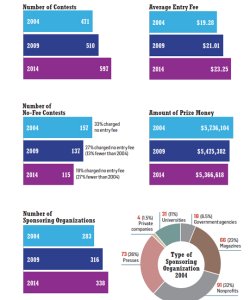
A breakdown of the numbers behind our Grants & Awards section, including the total amount of prize money given each year, the cost of entry, and how writing contests have changed over the past ten years.

Ron Charles of the Washington Post and the Totally Hip Video Book Review series gives his insights on the ethical and practical challenges of being a book critic for a major newspaper.

In Home for an Hour, an interdisciplinary collaboration between artist Adam Moser, writer Jacob Paul, and photographer Sarah Martin, seven couples are given free rein inside Moser’s apartment, while Paul composes stories about how the guests spend their time there.

A former radio executive writes about his behind-the-scenes experiences with rock stars, and puts his vast media expertise to work promoting the book. An editor and publicist weigh in.
Grove Atlantic and Electric Literature join forces to launch Literary Hub, a new site with an editorial team dedicated to curating the best literature-related writing on the Web.

The director of the Barnes & Noble Discover Great New Writers program talks about the process of searching for the “extraordinary storytelling” that makes a great new book.

Jennifer Joel, whose clients include Chris Cleave, Joe McGinniss Jr., Evan Osnos, and Shonda Rhimes, talks about the difference between selling fiction and nonfiction, what inspires her to go the extra mile for her authors, and what writers should really want out of publishing.

Melissa Febos, Jay Baron Nicorvo, and nine other authors share their stories of the major turning points they experienced.

In Ordinary Light, Pulitzer Prize–winning poet Tracy K. Smith embraces a fuller sense of herself as a writer while cementing the connection between her children and her ancestors using the best glue she knows: words.

The second installment of Reviewers & Critics features longtime book critic and culture essayist Roxane Gay, a true powerhouse in literary circles.
Small Press Points highlights the innovation and can-do spirit of independent presses. This issue features the Bedford, New York–based Fig Tree Books, which seeks to support the voices of American Jewish authors, publishing both new titles and rereleases of out-of-print works.

The increasing success and growth of a nonprofit writing center in Portland, Maine, reflects the incredible importance of storytelling in the lives of youths.
Literary MagNet chronicles the start-ups and closures, successes and failures, anniversaries and accolades, changes of editorship and special issues—in short, the news and trends—of literary magazines in America. This issue’s MagNet features Zoetrope: All-Story, Tweed’s Magazine of Literature & Art, the Normal School, Caketrain, and Irish Pages.
With so many good books being published every month, some literary titles worth exploring can get lost in the stacks. Page One offers the first lines of a dozen recently released books, including Kazuo Ishiguro’s The Buried Giant and Reif Larsen’s I Am Radar, as the starting point for a closer look at these new and noteworthy titles.
In the LGBTQ Writers in Schools program’s first district-wide partnership, Lambda Literary teams up with the second largest school district in California to bring LGBTQ books and authors to students.

The director of Bread Loaf’s new Translators’ Conferences talks about how the conference came about, what shape it will take, and what it means to be a translator in today’s literary culture.