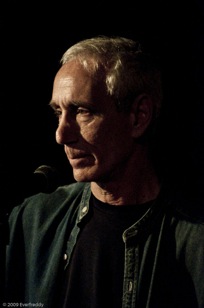
Joseph O. Legaspi on Kundiman's Ten Year Anniversary

Poet Joseph O. Legaspi cofounded P&W–supported Kundiman, a nonprofit organization that serves Asian American poetry. He blogs about Kundiman's beginnings and this year's ten-year anniversary celebrations. The author of Imago (CavanKerry Press) and the forthcoming chapbook Subways (Thrush Press), he lives in Queens, New York, and works at Columbia University.

In summer 2002, Sarah Gambito and I were swaying on a hammock at a backyard BBQ in Westchester. Watching the mostly Filipino crowd—families and community—playing games, eating, totally at ease with one another, we were mesmerized and even envious. As recent MFA graduates and young Filipino American poets trying to patch together literary lives in New York City, we felt alone and lost. We wanted to recreate the joyful and safe space that we witnessed in Westchester, but for Asian American artists. I then told Sarah about P&W–supported Cave Canem, a premiere literary organization that hosts a retreat for black poets. Two close friends, January Gill O’Neil and the late Phebus Etienne, attended the Cave Canem Retreat and raved about it. Why not? we asked ourselves, as there was already an impressive model, and in our hearts, we knew there was a void to fill. The rest, as they say, is history.

Kundiman now celebrates its ten-year anniversary! The sole organization of its kind, Kundiman remains dedicated to the creation and cultivation of Asian American writing. In summer 2013, we are hosting our tenth Kundiman Poetry Retreat with faculty members Li-Young Lee, Srikanth Reddy, and Lee Ann Roripaugh teaching workshops to our fellows. Over 120 fellows have attended the annual retreats under the tutelage of such renowned Asian and Asian American poets as Lawson Inada, Bei Dao, Myung Mi Kim, Marilyn Chin, Arthur Sze, Truong Tran, Paisley Rekdal, Aimee Nezhukumatathil, Rick Barot, and Tan Lin—many of whom have been supported by P&W over the years. Award-winning Kundiman fellows have published twenty books thus far with more titles forthcoming in 2014, in addition to over twenty chapbooks, and numerous print and online publications. Cofounder Sarah Gambito received the 2009 Barnes & Noble Writers for Writers Award. In partnership with Alice James Books, the Kundiman Poetry Prize is set to select its fourth winner this June. P&W–supported Matthew Olzmann’s Mezzanines, the second selection, was released in April 2013.

So, what’s in store for Kundiman’s tenth year? There will be a fundraising campaign with a target goal of $10,000. There will be exciting “10 for 10” events across the country, an NYC gala in the planning stages. Our website has already undergone a redesign. Kundiman’s oral history program, Kavad, will roll out fellow-driven projects that will provide new platforms to present and amplify Asian American voices. Kundiman remains strongly committed to fostering Asian American writing, which, in turn, empowers our marginalized, diasporic communities. Kundiman strives to transform the American literary landscape. Please come celebrate with us.

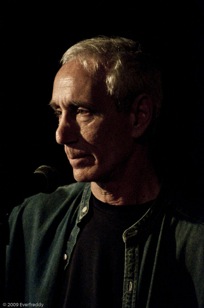
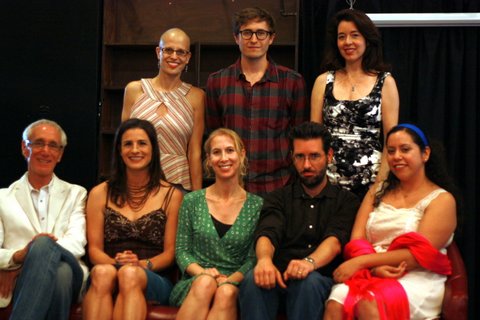
Photo: (Top) Joseph O. Legaspi. Credit: Emmy Cateral. (Bottom) Kundiman staff, faculty, and fellows. Credit: Dustin Parsons.

Support for Readings/Workshops in New York City is provided, in part, by public funds from the New York State Council on the Arts and the New York City Department of Cultural Affairs, with additional support from the Louis & Anne Abrons Foundation, the Axe-Houghton Foundation, The Cowles Charitable Trust, the Abbey K. Starr Charitable Trust, and the Friends of Poets & Writers.

Shapiro, Shaughnessy Shortlisted for Griffin Prize

The Toronto–based Griffin Trust for Excellence in Poetry has announced the shortlist for its 2013 Griffin Poetry Prize. Two awards of $65,000 each are given annually for poetry collections published during the preceding year, one by a poet living in Canada and another by a poet living internationally.

The international finalists include Like a Straw Bird It Follows Me, and Other Poems, by Ghassan Zaqtan and translated from the Arabic by Fady Joudah (Yale University Press), Liquid Nitrogen by Jennifer Maiden (Giramondo Publishing), Night of the Republic by Alan Shapiro (Houghton Mifflin Harcourt), and Our Andromeda by Brenda Shaughnessy (Copper Canyon Press). The Canadian finalists include What’s the Score? by David W. McFadden (Mansfield Press), Sailing to Babylon by James Pollock (Able Muse Press), and Personals by Ian Williams (Freehand Books). 

Judges Suzanne Buffam of Canada, Mark Doty of the United States, and Wang Ping of China each read 509 books of poetry from 40 countries, including 15 translations.

The seven finalists, who will be invited to participate in a reading in Toronto on June 12, will each receive $10,000. The two winners, to be announced at the Griffin Poetry Prize Awards ceremony on June 13, will each receive $65,000.

The Griffin Trust was founded in April 2000 by Scott Griffin, along with trustees Margaret Atwood, Robert Hass, Michael Ondaatje, Robin Robertson, and David Young. Carolyn Forché joined the roster in 2004. Prize judges are selected annually by the trustees, and the prizes are awarded in the spring of each year.

Publishers may submit books for consideration by the annual deadline of December 31. Visit the Griffin Trust website for more information and complete guidelines.

The Year You Were Born

4.11.13

Write an essay about the year that you were born. Research what was happening politically, socially, and environmentally, both in your town or city and around the world. Place yourself and your family among the events of that year, and try to find out where you fit into the picture of what was happening in the world.

Sentence Stealing

4.10.13

In Writers Recommend, author Alix Ohlin writes: “When I’m in direst need of inspiration, I do what I call ‘sentence stealing.’ I find a sentence from a writer I admire and write it down. ‘In the beginning I left messages in the street.’ Or, ‘Mrs. Dalloway said she would buy the flowers herself.’ Then I write my own version of the sentence, focusing only on its rhythms: by which I mean, replacing a noun with a noun, a verb with a verb. What’s left is a ghostly echo of the original sentence with no relationship to its actual content. And I follow that new sentence wherever it takes me, down the road to an unfolding story.” Using Ohlin’s method, write a story of your own.

Turn It Over

Choose a word or phrase you find yourself saying often (e.g. like, totally, hate, really, kind of) and write a poem using it as much as possible, turning it over and over, repositioning it, extending it, playing with its uses and the parts of speech into which it can be shaped.

Georgia Review Launches New Poetry Prize

The inaugural Loraine Williams Poetry Prize, sponsored by the Georgia Review, is currently open for submissions. A prize of one thousand dollars and publication in the Georgia Review will be given annually for a poem. Poets may submit up to three previously unpublished poems written in English, totaling no more than ten pages, with a fifteen-dollar entry fee by May 15. The editors will judge. 

The winning poem will be announced on August 15, and will be published in the Spring 2014 issue of the Georgia ReviewCurrent subscribers may enter the competition free of charge; nonsubscribers may choose to begin a subscription at the time of entry—thirty-five dollars for four issues, which is five dollars less than the regular price—in lieu of the entry feeSubmissions may be sent electronically or by mail to the Georgia Review, Loraine Williams Poetry Prize, 706A Main Library, 320 South Jackson Street, The University of Georgia, Athens, GA 30602. 

Founded at the University of Georgia in 1947, the Georgia Review is a quarterly print journal of poetry, fiction, creative nonfiction, reviews, and visual art. “Never stuffy and never shallow,” the editors write on the magazine’s website, “the Georgia Review seeks a broad audience of intellectually open and curious readers.” Past contributors have included established writers as Rita Dove, Stephen Dunn, Louise Erdrich, Philip Levine, Barry Lopez, Joyce Carol Oates, Natasha Trethewey, David Wagoner, and Paul Zimmer, as well as many new and emerging voices. 

For more information about the Georgia Review and for complete contest guidelines, visit the website

Joseph O. Legaspi on the Kundiman & Verlaine Reading Series

Poet Joseph O. Legaspi cofounded Kundiman, a nonprofit organization that serves Asian American poets. He blogs about curating P&W–supported Kundiman & Verlaine, a New York City–based reading series that has been running for ten years. The author of Imago (CavanKerry Press) and the forthcoming chapbook Subways (Thrush Press), he lives in Queens, New York, and works at Columbia University.

It started with an experiment. Before the poet Sarah Gambito and I fully conceived of Kundiman, the nonprofit we founded to serve Asian American poetry, there were the poems. At the time, in 2003, we were interested in the idea of poems as physical objects, as solid and tangible art pieces. We were also regulars imbibing lychee martinis at Verlaine, a bar on the lower east side of Manhattan where we befriended Gary Weingarten, a photographer and one of the owners of Verlaine. Presented with our idea, he provided us with the blank canvases: the walls inside Verlaine onto which we hung blown-up prints of poems. Words against a sheer white backdrop loomed large: our poems, as well as others by Prageeta Sharma and Li-Young Lee. Like a gallery, we hosted an opening with an amazing turnout.

When such a partnership presents itself, you run with it. The March 17, 2013, P&W–supported reading marked the tenth year of Kundiman & Verlaine, the only reading series that highlights Asian American poets. Over 130 readers have graced our stage, among them luminaries like Mei-mei Berssenbrugge, John Yau, Kimiko Hahn, Vijay Seshadri, Patrick Rosal, and Cathy Park Hong, along with emerging Asian American talents. In the spirit of community building, we have also invited poets from other literary circles like Cave Canem, LouderArts, and Acentos. Through the years, the series has exemplified the multiplicity and vitality of voices within the Asian American (and greater) literary community. At the March reading alone, for instance, were the following participants: Mandy Gor, a poet, painter, seamstress, and banker raised in Texas; Seni Seneviratne, a Sri Lankan living in England; and Kit Yan, a transgender spoken word phenomenon. The audience, from seemingly divergent backgrounds, were brought together by poetry. The Kundiman & Verlaine reading series embodies this spirit: big-hearted and celebratory. The lounge atmosphere helps, as well as the hour-long open bar before each reading.

The bottom line is that for a literary series to thrive, much generosity is needed: a place for gathering, a co-host/co-sponsor who shares your vision, an open-minded audience, and kind readers. Recently, another act of generosity: Poets & Writers, through its Readings/Workshops Program, has been able to provide honoraria to qualified readers. How lovely it’s been to compensate poets for their time and craft. Kundiman believes in paying poets, but because of our limited funds, we’ve been unable to do so—beyond the gift bags we give to readers as a token of our appreciation. Because of such patronage and generosity, the Kundiman & Verlaine reading series continues to be a welcoming, warm environment, full of heart.

Photo: (Top) Joseph O. Legaspi. Credit: Emmy Cateral. (Bottom, from left to right) Vikas Menon, Kit Yan, Seni Seneviratne, Mandy Gor, and Joseph O. Legaspi. Credit: JP Sevillano

Support for Readings/Workshops in New York City is provided, in part, by public funds from the New York State Council on the Arts and the New York City Department of Cultural Affairs, with additional support from the Louis & Anne Abrons Foundation, the Axe-Houghton Foundation, The Cowles Charitable Trust, the Abbey K. Starr Charitable Trust, and the Friends of Poets & Writers.

Notes of a Native Son

In the classic essay "Notes of a Native Son," James Baldwin writes about his relationship with his father, against the backdrop of a time of racial violence in America. Write an essay about your relationship with a parent and try to relate it to a larger aspect of the society and culture in which you were raised.

Saunders Wins PEN/Malamud Award

The PEN/Faulkner Foundation has announced that George Saunders will receive the 2013 PEN/Malamud Award. Given annually for a “body of work that demonstrates excellence in the art of short fiction,” the award comes with a five-thousand-dollar purse.

Considered a master of the short story, George Saunders’s most recent collection, Tenth of December, was published in January by Random House. A professor of creative writing at Syracuse University, his previous works include the story collections and novellas CivilWarLand in Bad Decline (1997), Pastoralia (2001), The Very Persistent Gappers of Frip (2005), The Brief and Frightening Reign of Phil (2005), and In Persuasion Nation (2007), and an essay collection, The Braindead Megaphone (2007). He is a regular contributor to the New Yorker, Harper’s, Esquire, GQ, and the New York Times Magazine. Saunders has received a MacArthur Fellowship, a Lannan Literary Fellowship, and four National Magazine Awards.

“Saunders is one of the most gifted and seriously comic short story writers working in America today,” said Alan Cheuse, a member of the Malamud Award selection committee, which is comprised of a panel of PEN/Faulkner directors. “And his comedy, like most great comedy, is dark….He's a Vonnegutian in his soul and, paradoxically, a writer like no one but himself.”

In addition to the prize money, PEN/Malamud Award winners are also invited to give a reading as part of the PEN/Faulkner Reading Series at the Folger Shakespeare Library in Washington, D.C. This year’s reading will take place in December. 

Established in 1988, the PEN/Malamud Award honors the late writer Bernard Malamud. Past winners have included, among others, John Updike, Saul Bellow, Eudora Welty, Grace Paley, Stuart Dybek, Joyce Carol Oates, Alice Munro, Junot Diaz, Lorrie Moore, Tobias Wolff, Amy Hempel, Nam Le, Edith Pearlman, and James Salter. 

Listen below as George Saunders discusses Tenth of December for the WNYC talk show Soundcheck.  

Based on History

Think about a person from history—Anne Boleyn, Martin Luther King Jr., Cleopatra, Abraham Lincoln—whose story you find compelling. Write a summary of this person's life, charting the ups and downs that made it remarkable. Using this summary as a plot, write a story that is set in the present and features a main character from your imagination.

Pages

Subscribe to RSS - blogs