What's Your Timeline?

3.14.13

Create a timeline that marks the major events of your life. Analyze it, looking for patterns or events that led to a series of others. Based on what you see, write an essay that explores one period of time—it could be a year, two years, a decade, or more. Think about how that time period informs the narrative of your life that you present to your friends, family, and acquaintances.

Eryn Green Wins Yale Younger Poets Prize

Yale University Press has announced the winner of the 2013 Yale Series of Younger Poets prize. Given annually since 1919 to a poet under the age of forty, the prize is the oldest literary award in the United States. 

Eryn Green of Denver received the 2013 prize for his collection, Eruv, which will be published by Yale University Press in April 2014. Judge Carl Phillips says that the winning work “reminds us how essential wilderness is to poetry—a wilderness in terms of how form and language both reinvent and get reinvented; meanwhile, the sensibility behind these poems points to another wilderness, the one that equals thinking about and feeling the world—its hurts, its joys—deeply and unabashedly, as we pass through it.”

Eryn Green is a doctoral candidate at the University of Denver and received an MFA from the University of Utah. His work has appeared in Jubilat, Colorado Review, Painted Bride Quarterly, and elsewhere. In addition to the publication of his book, he will also receive one of five writing fellowships offered at The James Merrill House in Stonington, Connecticut.

Green’s book will be the 108th volume in the Younger Poet series. Will Schutt’s Westerly, also chosen by Phillips, received the 2012 prize, and will be published in April. Past winners have included John Ashbery, Jack Gilbert, Robert Hass, Adrienne Rich, and Jean Valentine. 

Submissions for the 2014 prize will open this fall. Visit the website for more information and complete guidelines. 

Write This Story

3.13.13

You walk into a dimly lit room at a party where you’ve arrived with a friend. The walls of the room are lined with reptile cages. Across the room you see someone you recognize, and when you turn to your friend he or she is gone. What happens next?

Look and Listen

3.12.13

Today there are fifteen lines of poetry that will present themselves to you in various ways. Some will be visual, some will be spoken. Look and listen carefully. Take the time to record them. Then refine them and use them to craft a poem. 

Marianne Boruch Wins Kingsley Tufts Award

Claremont Graduate University has announced the winner of the Kingsley Tufts Poetry Award, given annually to a mid-career poet for a book published in the previous year. At $100,000, the Kingsley Tufts Award is one of the largest monetary poetry prizes in the United States.

The 2013 award has been given to Marianne Boruch of West Lafayette, Indiana, for her collection The Book of Hours, published by Copper Canyon Press. Heidy Steidlmayer of Vacaville, California, received the $10,000 Kate Tufts Discovery Award for her debut collection, Fowling Piece (Tri-Quarterly). The Kate Tufts Award is given annually for a first book by a poet.

“We are delighted to honor these poets and celebrate their achievements,” said Wendy Martin, director of the Tufts Poetry Awards program and vice provost at Claremont Graduate University, in a press release. “These awards will help them gain wider recognition and will sustain their continuing commitment to writing outstanding poetry.”  

The winners were selected from a list of finalists for each award. Boruch’s most recent books include the poetry collections Grace, Fallen from (Wesleyan, 2008) and Poems: New and Selected (Oberlin, 2004), and a memoir, The Glimpse Traveler (University of Indiana, 2011). Steidlmayer’s poems have appeared in Poetry, Ploughshares, Michigan Quarterly Review, and elsewhere. She has received a Rona Jaffe Foundation Writers’ Award and the 2012 Ploughshares John C. Zacharis Award.

Now in its twenty-first year, the Kingsley Tufts award was established at Claremont Graduate University by Kate Tufts to honor the memory of her husband. The award is presented for a work by a poet “who is past the very beginning but has not yet reached the pinnacle of his or her career.” The Kate Tufts Discovery Award was established in 1993 and is given annually for a debut collection.

The winners will be honored at a ceremony at the Garrison Theater in Claremont on Thursday, April 18. David Barber, Kate Gale, Ted Genoways, Linda Gregerson, and Carl Phillips judged.

Timothy Donnelly received the 2012 Kingsley Tufts Award; past winners include Robert Wrigley, Tom Sleigh, Matthea Harvey, Yusef Komunyakaa, and Chase Twichell.

To be considered for next year's awards, books published between September 1, 2012, and August 31, 2013, may be submitted by September 15. Visit the Claremont Graduate University website for more information and complete submission guidelines.

Make It Make Sense

Write an essay about a story or anecdote from your family lore that has never added up. Imagine various details of or revisions to the story that would make it make more sense.

Imaginary Friend

Write a poem in the form of a letter to an imaginary friend in which you ask them for help that begins, Dear Friend. Keeping the person or creature or entity you’re writing to in mind, include details and images that reveal your imaginary friend’s characteristics as you craft your entreaty.

Yale Announces Winners of New $150,000 Literary Prizes

The recipients of the inaugural Windham Campbell Prizes in fiction, nonfiction, and drama were announced this morning at Yale University. Each of the nine winners of the new prize will receive $150,000 to support their writing.

The winners in fiction are Tom McCarthy, James Salter, and Zoë Wicomb; the winners in nonfiction are Adina Hoffman, Jonny Steinberg, and Jeremy Scahill; the winners in drama are Naomi Wallace, Steven Adly Guirgis, and Tarell Alvin McCraney. 

Sponsored by Yale and established with a gift from the estate of the late writer Donald Windham, the Windham Campbell Literature Prizes recognize English-language writers at all stages of their careers. The prizes are named in honor of Windham and his longtime partner, the journalist and publisher Sandy M. Campbell. The prizes are administered by the Beinecke Rare Book Room and Manuscript Library, which also houses Windham’s papers. The awards join a list of esteemed literary prizes already sponsored by Yale, including the Bollingen Prize for Poetry and the Yale Series of Younger Poets.

“Yale is a place that hopes to inspire and recognize greatness in every field,” said Peter Salovey, president-elect of Yale University, in a press release. “The Windham Campbell Prizes allow us to fulfill that ambition in the field of world literature in ways we are only beginning to understand.”

There is no application process for the Windham Campbell Prizes. Established professionals in each category are asked to nominate names for consideration, and a selection committee meets at Yale to name up to nine writers to receive prizes. 

The winners of the inaugural prizes will receive their awards at a ceremony at Yale during the Windham Campbell Literary Festival from September 10 to September 13 in New Haven.

“I look forward to the dialogue the winners will inspire on the Yale campus and around the world,” Salovey said. “We will learn much from our prize-winners, particularly in these first years of awarding the prize.”

In the video below, Salovey announces the prize and the first annual winners.

Regie Cabico on Cupid Ain’t @#$%!: An Anti-Valentine’s Day Poetry Movement

P&W-funded Regie Cabico is the coeditor, with poet and novelist Brittany Fonte, of the recently published anthology of queer poetry and spoken word, Flicker and Spark (Lowbrow Press). His own work has appeared in over thirty anthologies, including Aloud: Voices from the Nuyorican Poets Café, Spoken Word Revolution, and Chorus & The Outlaw Bible of American Poetry. He received the 2006 Writers for Writers Award from Poets & Writers for his work teaching at-risk youth at Bellevue Hospital in New York. He is a former Artist in Residence at NYU's Asian Pacific American Studies Program and has served as faculty at Banff's Spoken Word Program. He resides in Washington, D.C.

I recently flew to Oakland to jump-start the debut of Cupid Ain’t @#$%!: An Anti-Valentine’s Day Poetry Movement. The series, started by J. Mase the III, has a strong, queer spoken-word bent, with poets of color and queer allies coming together to rail not just about love, but also about political identity through a humor and candor that you don’t get in a lot of poetry readings. In its fifth year, the series has gone to Philadelphia, New York, Washington, D.C., and Oakland. Having performed as a gay Filipino poet for the last twenty years, it occurred to me that the Cupid Movement is giving voice to a queer culture that embraces queer allies and also fosters an intergenerational queer positive environment.

I flew in from Washington, D.C., and into The Living Room Project, an Oakland-based organization devoted to healing, wellness, and serving the queer community. I rode the BART with poet Baruch Porras Hernandez, who curates the Queer Open Mic, the longest running series in the Bay. We were later joined by J. Mase, who flew in from Chicago, as well as trans comedian Natasha Muse. The Cupid show brought in an intimate crowd of a dozen or so: mainly queer folks who heard about the show from queer artists they had been following from New York. Deb Malkin, a college friend and her girlfriend, Cholla Soledad, showed up and made the reading a Valentine’s Day compromise—since Cholla is an anti-V-day cupid-downer. Deb is a Libra romantic. As a poet who performs constantly, you never know who will come or how many folks will show up.

Mase’s poem “Neighbor” was a big hit. The poem is about a homophobic neighbor who gives Mase nasty stares: “Queer people fuck better...and you know it because you live next door...to me.” Baruch’s poem on being “thin” is the best queer poem on body image: “If I were thin I would move a pile of needles naked from one room to another...and sleep with so many skinny boys in my bed because I’d be thin and we can lie in a line on the bed...” Natasha Muse broke her stand-up set into progressions during which she spoke of coming out as trans, starting out as Ewan McGregor and then ending up looking like Nicole Kidman, so watching Moulin Rouge hits her in a very personal way. Natasha concluded her set by talking about becoming a mom and living with her female spouse. The evening had some of the best comedic queer material that I have come across. The owner of The Living Room Project, Micah Hobbes, was impressed by the talent and acknowledged humor as a healing tool.

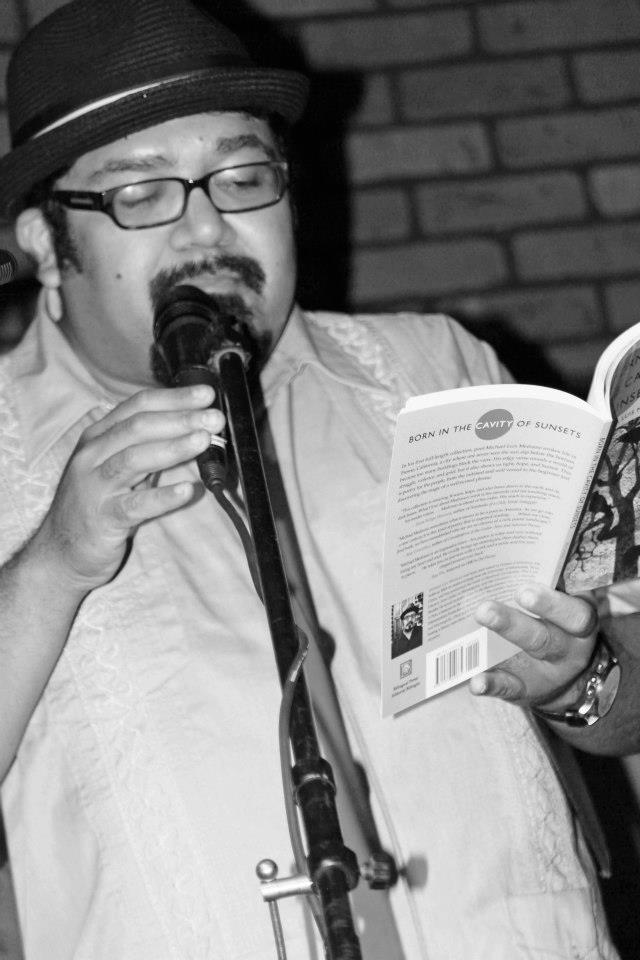
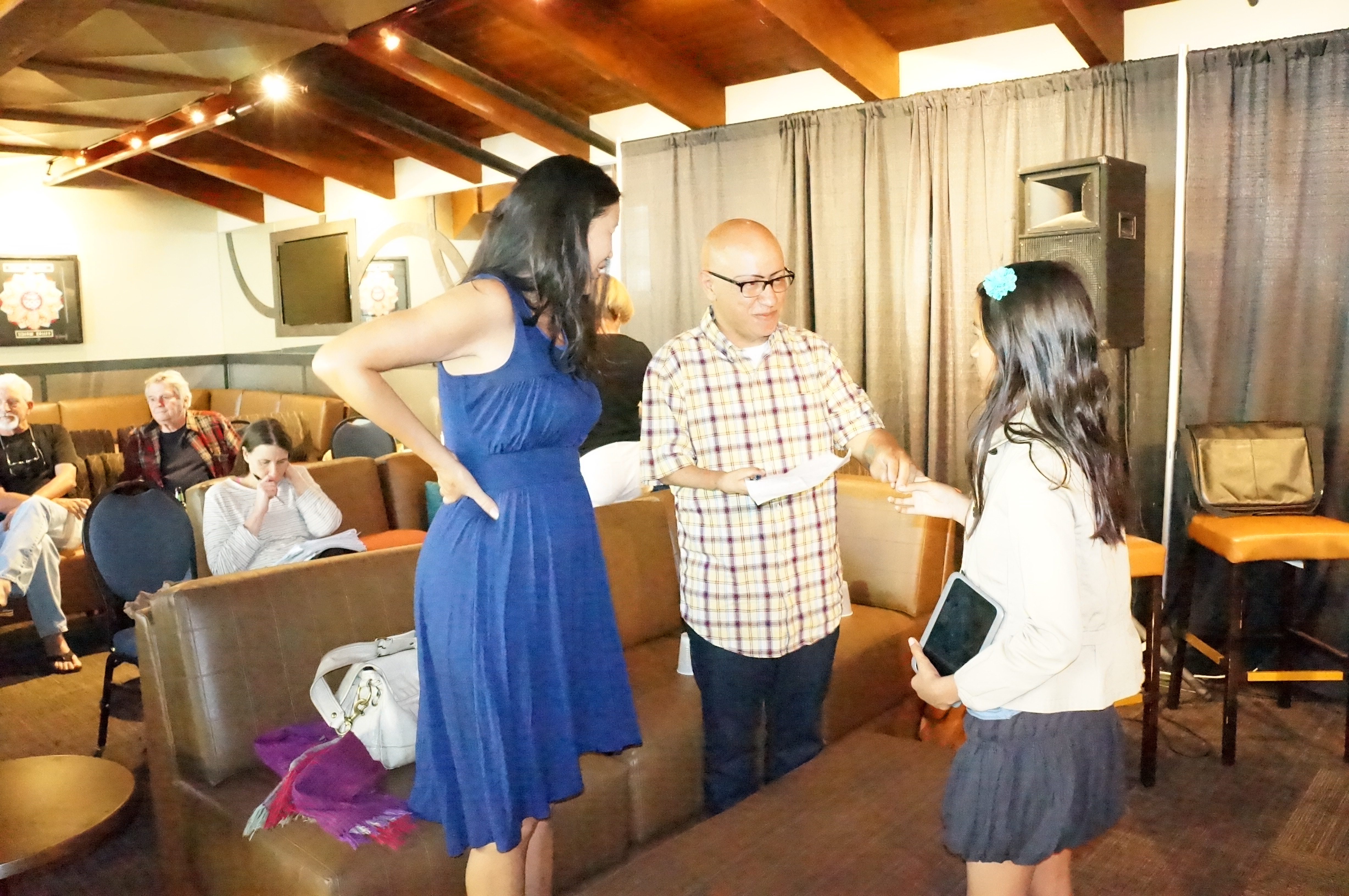
Photos: (Top) Regie Cabico. Credit: Carlos Rodriguez (Bottom) From left to right: J Mase III, Natasha Muse, Baruch Porras-Hernandez, Regie Cabico.

Support for Readings/Workshops events in Washington, D.C. is provided by an endowment established with generous contributions from the Poets & Writers Board of Directors and others. Additional support comes from the Friends of Poets & Writers.

Pages

Subscribe to RSS - blogs