Crushed Marigold

I am excited to share my thoughts after reading Christiana Castillo’s poetry chapbook, Crushed Marigold, illustrated by and Karla Rosas and published by Flower Press, a Detroit-based publishing practice centering womxn, femme, queer, and trans artists. Castillo is a Latina/Chicana poet, teaching artist, and gardener born in Rio de Janeiro, Brasil and living in the Detroit area. She is the recipient of fellowships from Room Project, Voices of Our Nation (VONA), and Disquiet International.

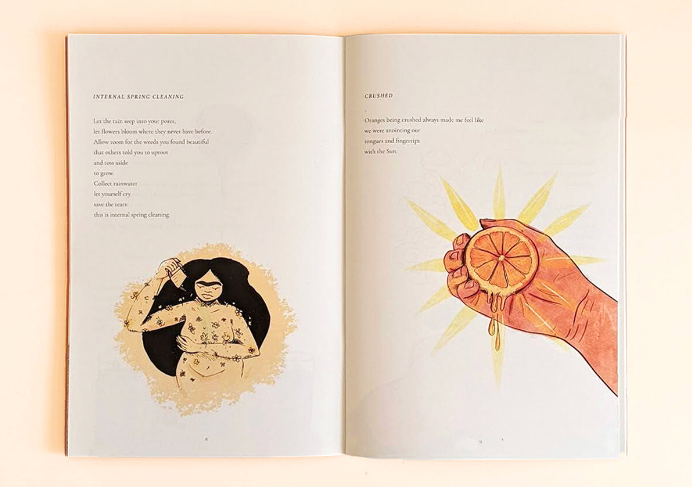
Castillo joined the Writing in Detroit virtual reading last October, sponsored by Poets & Writers, which offered an inspiring insight to her writing style and bright imagery. Crushed Marigold further expounds upon her writing with colors and textures juxtaposed against the theme of brown skin. In addition, the warm illustrations by artist Karla Rosas throughout the book leave the reader wondering what world we will be pulled into next with each poem.

A favorite poem of mine from Castillo’s collection is “Questions for the Moon,” which asks: “Does the Moon practice self care? / Does she have the time? / I know she controls the / tides / and the water within / us all / but / can she control herself?” The poem gently personifies the moon in a way that opens the reader’s mind to consider how the world around us not only responds to us, but how it responds to itself. The entire collection made me reconsider how we interact with the everyday aspects of our own cultures.

This collection also leaves me with a feeling of hope and perseverance with couplets like “in the midst of decay / there are always more seeds sprouting.” While Castillo touches on heavier topics such as colonization, there is always a sense of moving forward, of growth, of survival.

Crushed Marigold is available at Flower Press’s website and a percentage of the proceeds goes to American Indian Health and Family Services in Michigan, and Kooyrigs, an organization that provides resources to Armenian communities worldwide.

Photo: An open page of Crushed Marigold by Christiana Castillo, illustrated by Karla Rosas.
 
Justin Rogers is the literary outreach coordinator for Poets & Writers in Detroit. Contact him at Detroit@pw.org or on Twitter, @Detroitpworg.

Big Bad Wolf

4.21.21

“First, grant me my sense of history,” writes Agha Shahid Ali in his poem “The Wolfs Postscript to Little Red Riding Hood” in which he reimagines the classic fairy tale from the perspective of the story’s villain. “And then grant me my generous sense of plot: / Couldn't I have gobbled her up / right there in the jungle?” The poem offers a complicated portrait of the “Big Bad Wolf,” including disturbing confessions and provocative questions that reexamine this allegory and consider the power of perspective in storytelling. Write a story that explores the perspective of a villain in a children’s story you know well. What new information will you include about this character? What, perhaps, was left out of the story?

Ghazal

4.20.21

Kayleb Rae Candrilli’s poem “Ghazal Connected as Though Cargo Freights,” winner of Winning Writers’ Tom Howard/Margaret Reid Poetry Contest for traditional verse, uses the Persian poetic form as a way of capturing the landscape in which the speaker grew up as a trans child while balancing the taut music of the line with a narrative propulsion that grounds the story. The ghazal, which originated in seventh-century Arabia, consists of at least five couplets that are structurally autonomous—the first stanza ending both lines with the same word and each stanza that follows repeating the same word at the end of the second line. This week, write a ghazal that explores your childhood. For more guidance on the history of the form and to read examples, visit the Poetry Foundation’s glossary entry on the ghazal.

Deadline Approaches for the Backwaters Prize in Poetry

The Backwaters Prize in Poetry is accepting submissions. Established in 1998, the prize is awarded for a book-length poetry manuscript. The winning writer will receive $2,000, publication by the Backwaters Press, and 20 author copies. An honorable mention prize of $1,000 and publication by the Backwaters Press will also be given.

Using only the online submission system, submit a manuscript of 60 to 85 pages with a $30 entry fee by May 1. Huascar Medina will judge. Visit the website for complete guidelines.

Founded in 1997, the Backwaters Press was acquired by the University of Nebraska Press (UNP) in 2018. Operating as a distinct imprint within UNP, Backwaters seeks to “plant its roots firmly in the Great Plains, delighting readers with literature of enduring value and consequence.” The winner of the 2020 prize was Nathaniel Perry for Long Rules: An Essay in Verse, which is forthcoming in November.

Rovering

4.15.21

Last summer a ten-minute video released by ElderFox Documentaries, a YouTube channel devoted to space exploration, went viral as users responded to its remastered and stitched-together images of the planet Mars, rendered in 4K resolution and captured by NASA’s high-tech rovers. What has been described as “the most lifelike experience of being on Mars” includes clear panoramas of the planet’s landscape—including the Gale crater, Cape Verde, the Santa Maria crater, and the entrance to the Marathon Valley, all named by NASA for their distinctive spaces, color schemes, and geological properties—as well as evidence pointing to possible signs of life. Using the landscape of Mars as inspiration, write an essay exploring uncharted territory from your past. Consider writing short vignettes that mimic the cut-and-paste techniques employed in the video.

I Am New Orleans Anthology Reading

On April 1, poets from the anthology I Am New Orleans, published last September by the University of New Orleans Press, kicked off the 2021 New Orleans Poetry Festival with a reading. Edited by Kalamu ya Salaam, the anthology includes thirty-six poets who revisit and celebrate Marcus B. Christian’s definitive poem of the same name.

The event was broadcast live from Café Istanbul, a popular event space in the city for music and poetry, and poets beamed in from their homes to share their work. There was a limited in-person audience and many watching virtually. For a lot of writers who hadn’t seen each other since before the pandemic, the reading served as a virtual reunion. There were shout-outs and “hey, how you doing?” messages filling up the chat.

The reading featured editor Kalamu ya Salaam along with poets Kristina Kay Robinson, Akilah Toney, Michael “Quess” Moore, Skye Jackson, Jahi Salaam, Chuck Perkins, and Frederick “Hollywood” Delahoussaye. I was also honored to take part as a reader and enjoyed this celebratory event, a launch to both the festival and to National Poetry Month.

See the entire New Orleans Poetry Festival schedule for more virtual events throughout the month of April. 

Watch the I Am New Orleans reading here:

Kelly Harris is the literary outreach coordinator for Poets & Writers in New Orleans. Contact her at NOLA@pw.org or on Twitter, @NOLApworg.

Index of Experience

4.14.21

Amy Gerstler’s book of poems Index of Women, published last week by Penguin Books, depicts experiences of womanhood through a number of forms and perspectives, including a dramatic monologue from an aging opera singer, an ode to a head of lettuce, and prose poems recounting personal memories. The second poem in the collection, “Virginity,” builds an atmosphere around the experience of having sex for the first time, without ever naming the act itself. Through subtle details that hark back to adolescence—“passing notes rather than speaking” and “reading secret magazines a cousin stuffed / into the bottom of his sleeping bag”—Gerstler avoids cliché and develops the speaker’s voice using the oft-mythologized moment of losing one’s virginity, offering instead a sense of the speaker’s life that isn’t defined by sex. Write a series of scenes that study a character experiencing a key life moment without ever explicitly naming the experience itself. What is revealed or emphasized by gesturing to details that surround the experience?

Poem for You

4.13.21

In an afterword to The Essential June Jordan, edited by Jan Heller Levi and Christoph Keller and forthcoming in May by Copper Canyon Press, Pulitzer Prize–winning poet Jericho Brown writes about how the legacy of June Jordan, who died in 2002, “allows another opportunity to think not only about what poems are, but also what poems can do.” In this definitive volume the celebrated poet’s voice shines as she explores difficult subject matter, such as racist police brutality and violence against women, with a commitment to global solidarity and radical kindness. She dedicates many of her poems to lovers and friends, along with historical and pop culture figures, including “1977: Poem for Mrs. Fannie Lou Hamer,” “Poem for Mark,” and “Poem on the Death of Princess Diana.” Taking inspiration from Jordan, write a poem that is dedicated to a single person. Consider using your new poem’s title to help frame a complicated subject.

Wildflowers

“I was enamored with the notion that all I had to do to drive the sadness away, to have something to look forward to, was open a can of meadows,” writes Kathy Davis in her essay “There’s No Simple Way to Make it OK,” published in Guernica, in which she meditates on cultivating a meadow of wildflowers after the death of her parents. “But as the blooms started to fade, nothing I’d planted could ward off the midsummer takeover of weeds and wiregrass,” writes Davis. “Gardening, I was learning, is not easy. Like grief, it’s a process.” Write an essay about an activity, like gardening, that helped you come to terms with a difficult time in your life.

Useless Stuff

Amy Hempel’s short story “In the Cemetery Where Al Jolson Is Buried” begins with a conversation between two best friends in which the narrator keeps her ill friend company in the hospital by telling her random facts. “Make it useless stuff or skip it,” requests the friend. The story then hooks the reader with a series of tall tales and jokes that entertain both the sick friend and the reader alike, serving as context for their close relationship and a unique introduction for the heart-wrenching story. Write a short story that begins with, or uses throughout, trivia or jokes as a way of developing the relationship between two key characters.

Pages

Subscribe to RSS - blogs