New Day

12.31.20

“The day that changed my life was like every other day before it, except that it changed my life.” Mateo Askaripour’s debut novel, Black Buck, forthcoming from Houghton Mifflin Harcourt in January, sets up anticipation in the first chapter by starting on the day when everything changed for the protagonist, Darren. Ordinary activities and smells are described, inviting the reader in while building suspense for the change to come. “The house smelled as it always did at 7 a.m.—like coffee. It made me want to puke.” Write an essay that walks the reader through a regular day in your life when you felt the circumstances of it change, whether big or small.

Loony

12.30.20

In Olivia Rutigliano’s essay “Thirty Years Later, Home Alone Has a Lot to Say About Adulthood” published in CrimeReads, she describes the appeal of the classic Christmas movie, likening its comedy to a cartoon: “Home Alone possesses the same slapsticky buoyancy and physical elasticity of Looney Toons; no matter how many anvils are dropped on the aggressors, they’ll still spring back up a few moments later and resume the pursuit at hand.” Write a flash fiction piece in which the actions are described in a hyperbolized, almost cartoonish way. How does this challenge your sense of description?

‘Tis the Season for Reading

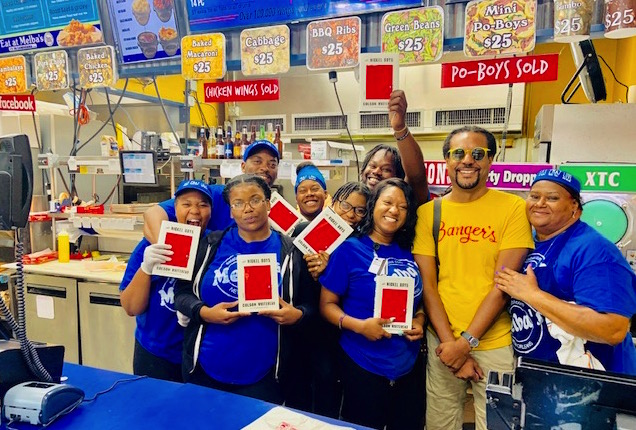
What word would you use to describe 2020? I pick the word: grateful. Despite this year’s challenges, writers in New Orleans and its surrounding areas have continued to create and contribute to a vibrant writing community that has found amazing ways to thrive in uncertain times. For this, I am grateful. If you’re looking for ways to support and give back, here are a few of my recommendations to help support the New Orleans literary community and its writers, and your own community:

Buy from local bookstores: Help stimulate your local economy and small businesses by shopping at your local bookstores. Circulate local dollars. Many have been able to transition to curbside pickup or online orders during the pandemic. Search for local bookstores in your area with the Literary Places database and read my post on New Orleans bookstores.

Purchase books by local authors: Ask your neighborhood independent bookstore or public library to point you in the direction of local writers. Or take it upon yourself to do a little online research, many writers have social media accounts you can follow on Facebook, Instagram, and Twitter where you might even connect.

Sharing is caring: See news about a local writer online? Retweet, share, tag. Help promote your favorite writers and the city.

Donate to local literary organizations: Invest in the literary future of New Orleans by donating to organizations like One Book One New Orleans, 826 New Orleans, Runagate Press, and Friends of New Orleans Public Library. Find an organization (or writer) that reflects your passion and stuff their stocking with a donation of any size.

Help Poets & Writers support writers in New Orleans and beyond: Become a friend of Poets & Writers and help support the resources of this website and programs that give back to the literary community.

Finally, have a safe and healthy remainder of the year. We’ll return in 2021 with more literary news to share with you.

Kelly Harris is the literary outreach coordinator for Poets & Writers in New Orleans. Contact her at NOLA@pw.org or on Twitter, @NOLApworg.

Commencement

12.29.20

“Young walruses, we must all adapt!” begins Matthew Olzmann’s “Commencement Speech, Delivered to a Herd of Walrus Calves,” published in Four Way Review. In the poem, as the title reveals, a speaker offers advice to a herd of walruses on courage, evolution, and survival: “You need to train yourself to do what they won’t expect.” Write a poem in the form of a speech addressed to a group of animals or objects that offers advice and encouragement for challenges only the subject could encounter. Try to use the title, as Olzmann does, to set the scene and the tone for the poem.

Blue

12.24.20

Amy Key’s essay “A Bleed of Blue,” published this month in Granta, begins with a white lie: “I wasn’t in LA because of Joni Mitchell, but that was what I had told my Lyft driver and it felt good to have a story.” The essay meditates on Mitchell’s iconic 1971 album Blue, and reflects on Key’s memories listening to it as a teenager with her friend who had just begun experiencing menstruation: “In my memory of that night, the lava lamp was like the pain my friend was experiencing, the hot red pulse of it.” Song by song, Key recounts her memories of Los Angeles and her emotional connection to Mitchell’s songwriting. Choose a music album that’s meant a lot to you, then write an essay that reflects on how the experience of listening to each song transformed you.

Year in Reflection: 2020

I am in awe of the effects of time on the city of Detroit as I write this final blog post for the year of 2020. A different world has taken shape since December of last year. The landscape of how writers and non-writers alike engage with the literary arts has changed just as much. In Detroit, streamed virtual events, online book sales, and Facebook Live panels have taken the place of in-person poetry nights, storytelling events, and all festivals. While a tough move for all of us, it has also afforded writers the ability to speak with wider audiences despite where they are physically located. Considering the long-standing transportation issues that exist within the city, there is a new sort of connectedness that has come from these virtual readings. Readings by Aricka Foreman, Nandi Comer, and Tommye Blount come to mind as highlights of 2020. 

I’ve found myself deeply appreciative of Detroit’s dedication to providing quality literary events and programming. I recall InsideOut Literary Arts’ Louder Than a Bomb Detroit Youth Poetry Festival, which pivoted to a completely online model just weeks after statewide shutdowns. That festival provided youth with numerous workshop and reading opportunities that allowed for direct reflection on the pandemic. I also remember M. L. Liebler’s virtual adaptation of the Detroit Lit Walk, which invited viewers to engage with seven artists from the comfort of their home. These examples and more represent the resiliency of writing as an art form, and sharing that writing as a form of expression. 

Great things have also come out of the United States of Writing this year! I have to commend Lupe Mendez of Houston and Kelly Harris of New Orleans for leading amazing events in their hometowns and allowing all of us to get a taste of their literary communities through this blog. Poets & Writers’ funding through 2020 Project Grants for BIPOC Writers and rolling out Readings & Workshops mini-grants for virtual events have given each of our cities the means to expand our literary communities like never before. We look forward to continuing this great work in 2021.

Justin Rogers is the literary outreach coordinator for Poets & Writers in Detroit. Contact him at Detroit@pw.org or on Twitter, @Detroitpworg.

Living Room

12.23.20

“They listened to the news in the front room, their bodies as still as the mounted deer on the wall behind them.” In Idra Novey’s short story “Husband and Wife During the Nightly News,” a married couple go through their routine of watching the news, the husband commentating while expecting the wife to murmur in agreement, a sequence they stick to “as if the very beams of their house depended on it.” The setting of the living room adds meaning onto the ritual of their marriage, and still objects begin to take life, ending with the wife feeling as if she had “ripped off the doe’s furred skin with her teeth.” Write a story that features a character whose living area directly reflects the conflicts being faced. How can inanimate objects be used to express emotions?

Red

12.22.20

Mars Being Red” by the late poet Marvin Bell lyrically explores the color red as a state of being, likening it to a list of images that both physically resemble the color and provide memories, such as that of youth. In this compact, twelve-line poem, Bell begins what seems to be a portrait of the planet Mars and then delves into a series of digressions that find resolve in a meditation on the possibility of change: “You will not be this quick-to-redden / forever. You will be green again, again and again.” Inspired by Bell, write a poem that serves as a portrait of a color. Use physical descriptions to begin and then personal memories to develop a transformation in this study of hue.

Upcoming Contest Deadlines

Consider setting aside time this holiday season to submit to the last writing contests of the year. With deadlines of either December 30 or December 31, these awards, all of which offer a cash prize of at least $500, include opportunities for both manuscripts and published works. Plus, six of the contests require no entry fee. 

Black Caucus of the American Library Association Literary Awards: Four prizes of $500 each are given annually for a poetry collection, a first novel, a book of fiction, and a book of nonfiction (including creative nonfiction) by African American writers published in the United States in the previous year. The awards honor books that depict the “cultural, historical, and sociopolitical aspects of the Black Diaspora.” Publishers may nominate books published in 2020. Deadline: December 31. Entry fee: none.

Boulevard Short Fiction Contest for Emerging Writers: A prize of $1,500 and publication in Boulevard is given annually for a short story by a writer who has not published a nationally distributed book. The editors will judge. All entries are considered for publication. Deadline: December 31. Entry fee: $16 (includes subscription).

Cleveland Foundation Anisfield-Wolf Book Awards: Three to four prizes of $10,000 each are given annually for a poetry collection, a book of fiction, and a book of nonfiction (including creative nonfiction) published during the previous year that “contribute to our understanding of racism and appreciation of cultural diversity.” Rita Dove, Henry Louis Gates Jr., Joyce Carol Oates, Steven Pinker, and Simon Schama will judge. Deadline: December 31. Entry fee: none.

Codhill Press Poetry Award: A prize of $1,000, publication by Codhill Press, and 25 author copies is given annually for a poetry collection. James Sherwood will judge. All entries are considered for publication. Deadline: December 30. Entry fee: $30.

Crosswinds Poetry Contest: A prize of $1,000 and publication in Crosswinds is given annually for a single poem. Margaret Gibson will judge. All entries are considered for publication. Deadline: December 31. Entry fee: $20.

Florida Review Jeanne Leiby Memorial Chapbook Award: A prize of $1,000 and publication by Florida Review is given annually for a chapbook of short fiction, short nonfiction, or graphic narrative. All entries are considered for publication. Deadline: December 31. Entry fee: $25.

Griffin Trust for Excellence in Poetry Griffin Poetry Prize: Two prizes of $65,000 CAD (approximately $50,824) each are given annually for poetry collections published during the previous year by a Canadian poet or translator and by an international poet or translator. Finalists in each category receive $10,000 CAD (approximately $7,820) for their participation in the Griffin Poetry Prize Shortlist Readings held in Toronto. Deadline: December 31. Entry fee: none.

Kallisto Gaia Press Acacia Fiction Prize: A prize of $1,200 and publication by Kallisto Gaia Press is given annually for a collection of short works of fiction. Richard Z. Santos will judge. Deadline: December 31. Entry fee: $25 (includes a copy of the winning collection). 

Kallisto Gaia Press Saguaro Poetry Prize: A prize of $1,200 and publication by Kallisto Gaia Press is given annually for a poetry chapbook. ire’ne lara silva will judge. Deadline: December 31. Entry fee: $25 (includes a copy of the winning collection).

Lascaux Review Prize in Short Fiction: A prize of $1,000 and publication in Lascaux Review is given annually for a short story. Previously published and unpublished stories are eligible. All entries are considered for publication. Deadline: December 31. Entry fee: $15.

LitMag Virginia Woolf Award for Short Fiction: A prize of $2,500 and publication in LitMag is given annually for a short story. The winner will have their work reviewed by agents from Bankoff Collaborative, the Bent Agency, Brandt & Hochman, Folio Literary Management, InkWell Management, Sobel Weber Associates, and Triangle House Literary. The editors will judge. All entries are considered for publication. Deadline: December 31. Entry fee: $20.

Moth Poetry Prize: A prize of €6,000 (approximately $7,342) and publication in the Moth is given annually for a single poem. Three runner-up prizes of €1,000 (approximately $1,224) each are also given. The four shortlisted poets, including the winner, will also be invited to read at an awards ceremony at the Poetry Ireland festival in Dublin in spring 2021. Nick Laird will judge. Deadline: December 31. Entry fee: €15 (approximately $18) per poem. 

Poetry Society of America Alice Fay di Castagnola Award: A prize of $1,000 and publication on the Poetry Society of America website will be given annually for a group of poems from a manuscript-in-progress. Elisa Gabbert will judge. Deadline: December 31. Entry fee: $15.

Poetry Society of America Four Quartets Prize: A prize of $20,000 is given annually for a unified and complete sequence of poems published in the United States. in a print or online journal, a chapbook, or a book. Three finalists, including the winner, will receive $1,000 each. Carolyn Forché, Donika Kelly, and Arthur Sze will judge. Deadline: December 31. Entry fee: none.

Poetry Society of America Robert H. Winner Memorial Award: A prize of $2,500 and publication on the Poetry Society of America website is given annually to a poet over 40 who has published no more than one book. Heid E. Erdrich will judge. Deadline: December 31. Entry fee: $15.

Press 53 Award for Short Fiction: A prize of $1,000, publication by Press 53, and 50 author copies is given annually for a story collection. Kevin Morgan Watson will judge. Deadline: December 31. Entry fee: $30. 

River Styx Micro-Fiction Contest: A prize of $1,000 and publication in River Styx is given annually for a short short story. All entries are considered for publication. Deadline: December 31. Entry fee: $15 (includes a copy of the prize issue) or $20 (includes subscription).

Tupelo Press Dorset Prize: A prize of $3,000 and publication by Tupelo Press is given annually for a poetry collection. The winner also receives a weeklong residency at the Massachusetts Museum of Contemporary Art. Tyehimba Jess will judge. All entries are considered for publication. Deadline: December 31. Entry fee: $30.

Virginia Commonwealth University Cabell First Novelist Award: A prize of at least $3,000 is given annually for a first novel published during the previous year. The winner and two additional guest panelists (usually the winner’s agent and editor) will also receive lodging and travel expenses to attend the First Novelist Award Night at Virginia Commonwealth University in fall 2021. Deadline: December 30. Entry fee: none.

Visit the contest websites for complete guidelines, and check out the Grants & Awards database and Submission Calendar for more contests in poetry, fiction, and creative nonfiction.

A Fresh Start

12.17.20

New Year’s traditions range across cultures and families. Rolling empty suitcases around the block to increase one’s chances of traveling, pounding rice to make mochi for good fortune, eating lentils to herald prosperity, and enjoying twelve grapes for twelve wishes are just a few of the traditions whereby folks start anew and connect with their roots. Some of these practices, such as kissing at midnight for romantic luck and throwing pails of water out a window to chase away evil spirits, date back a century or more. What are some of your New Year’s traditions? How is the way you celebrate uniquely yours? Write an essay that describes your New Year’s traditions, traces their cultural lineages, and tells the story of how you learned them.

Pages

Subscribe to RSS - blogs